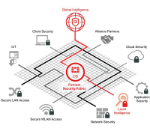
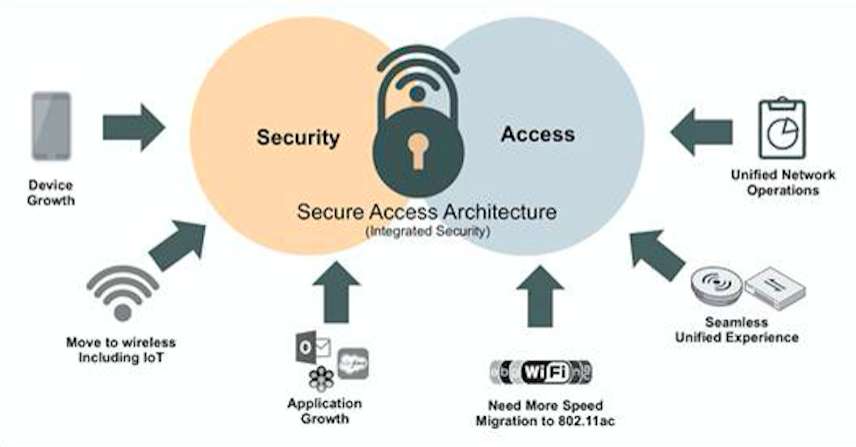
Security in large organizations today is akin to the fable about the blind men and the elephant. When your security tool touches just one area of the business – be it mobile, cloud, Internet of Things (IoT), endpoints or the data center – none have visibility across the whole attack surface. And that leaves the entire enterprise vulnerable to attack.
Large enterprises that take a defense-in-depth strategy by layering point solutions in the hopes of shoring up the gap, end up with complexity and incompatibility between solutions – increasing vulnerability. This approach results in siloed security solutions, each with their own configuration, deployment and management idiosyncrasies. Alerts and threat indicators produced from multiple products cannot be correlated or prioritized to cut through the noise, meaning that the true indicators of compromise go undetected.
The Big Picture
You need to simplify your security infrastructure without making compromises. To secure the enterprise – endpoints, access layer, network, applications, data center, mobile, the cloud, etc. – with a holistic approach means that products communicate and collaborate seamlessly to provide a big-picture view. A collaborative solution that can be orchestrated and managed through a single pane of glass provides a stronger overall security posture and lowers risk.
True enterprise security must be:
Scalable, meeting large enterprises’ volume and performance demands, while providing visibility end-to-end, including deep inspection of packet data, application protocols and analysis of unstructured content.
Aware, enabling the network to be intelligently segmented into functional security zones, while behaving as a single unified network from a policy and logging perspective.
Secure, enabling true collaboration to foster sharing of global and local threat intelligence and threat mitigation information.
Actionable, including the ability to dynamically adapt to the changing threat landscape and respond to threats in a coordinated fashion.
Open, supporting well-defined open application programming interfaces (APIs) that enable technology partners to collaborate at critical interaction points, including at the hypervisor, SDN orchestration controller, the cloud, the sandbox and logging/policy management.
The end result? Simplified security management, increased visibility, reduced vulnerability and lower risk.
The Fortinet Security Fabric provides the collaborative, secure environment required by an enterprise to do business across physical, virtual, mobile, IoT and cloud environments to adapt and defend against the evolving threat landscape – without adding complexity or making a performance compromise. Learn more.